SSM Smart Square: the complete login and scheduling guide for SSM Health staff (2026)
If you work at SSM Health and you’ve ever scrambled for a paper schedule, hunted down a charge nurse to swap a shift, or shown up for a shift change nobody communicated, this article is for you.
SSM Smart Square is the workforce scheduling platform used across SSM Health’s 24 hospitals and 540+ physician offices in Illinois, Missouri, Oklahoma, and Wisconsin. SSM Health operates one of the largest integrated healthcare networks in the Midwest, with more than 40,000 team members and 15,000 providers. Coordinating that many people across that many facilities, manually, would be a logistical nightmare.
Smart Square is how they don’t.
What is SSM Smart Square?
SSM Smart Square is a workforce scheduling and staffing platform used by SSM Health, developed by Avantas, a company that specializes in workforce optimization for healthcare organizations.
The short version: it replaces spreadsheets, phone trees, and last-minute shift scrambles with one centralized system. Staff see their schedules weeks out, pick up open shifts, request time off, and swap with colleagues. Managers see real-time staffing levels by unit, flag gaps before they become emergencies, and track labor costs alongside every scheduling decision.
SSM Smart Square is not open to the general public. Access is limited to authorized employees, contractors, and approved staff members within the SSM Health system. Your account gets created during onboarding, and your credentials come from HR or your department manager.
How to complete the SSM Smart Square login
The process is straightforward once you have your credentials.
Go to ssm.smart-square.com. Enter your SSM Health network username and password. Hit the Sign In button. If enabled, you’ll go through SSO or MFA steps.
Here’s each step in plain terms:
Step 1: Open Chrome, Edge, Safari, or Firefox on your device. SSM Smart Square is a cloud-based platform, so it works through secure web portals and mobile apps. A stable internet connection is essential since schedules and updates load in real time.
Step 2: Go to ssm.smart-square.com. Bookmark it so you’re not searching for it every shift.
Step 3: Enter your SSM Health username and password. These are the same credentials your IT department issued during onboarding.
Step 4: If your facility uses SSO (Single Sign-On), you’ll authenticate once and gain access to Smart Square alongside your other SSM systems. If prompted for MFA, approve it through your authentication app (Duo, Microsoft Authenticator, or whatever SSM IT set you up with).
Step 5: You’re in. Your dashboard shows your schedule, open shifts on your unit, and any pending requests.
One thing worth knowing: some campuses may use slightly different portal URLs with regional identifiers in the domain name. If the URL above doesn’t work, check with your manager or SSM’s IT help desk. Your facility’s specific login link is the one to bookmark.
Forgot your SSM Smart Square password?
Click the “Forgot Password” button on the login page. Enter your username and email. You’ll receive a reset link to create a new password.
The reset email comes from the Smart Square system within a few minutes. Follow the link, set a new password, and log back in. If you’re not getting the email, check your spam folder first, then contact SSM IT support.
If you’ve lost your MFA device, there’s a self-service recovery option, but get in touch with the help desk quickly. MFA issues are the second most common login problem after forgotten passwords.
What SSM Smart Square actually does
Scheduling sounds like a solved problem. It’s not. The very nature of hospitals is complex: patient load changes, emergencies arise, staff may or may not be available. Smart Square reduces scheduling errors, avoids understaffed shifts, clarifies scheduling for all parties, and sometimes even improves work-life balance.
Here’s what the platform handles day-to-day:
Schedule visibility. Staff see their confirmed shifts, pending requests, and their unit’s coverage levels — weeks in advance. In healthcare, knowing your schedule 4-6 weeks out is genuinely useful. Most manual scheduling systems barely managed 2 weeks.
Shift swapping. Smart Square allows shift swaps, open shift filling, and schedule visibility from one place. You post a shift you can’t cover, eligible coworkers get notified, someone picks it up. The whole thing happens in the system, not in a group chat.
Time-off requests. Submit PTO directly through the portal. You can see how much coverage your unit already has before you submit, which cuts down on the frustration of having a request denied with no explanation.
Open shift bidding. Managers post open shifts, staff bid on them. The platform aligns staff availability with patient needs and workload distribution in real time for optimal scheduling. This matters because a voluntary pickup is always cheaper and less disruptive than a mandated overtime shift.
Real-time staffing alerts. The platform provides live updates on staff availability and scheduling changes, ensuring that the team always has the most current information. Managers see gaps forming before they become 11pm emergencies.
Payroll integration. Hours worked sync directly to payroll. No manual reconciliation, no data entry errors.
Compliance tracking. Overtime thresholds, back-to-back shift restrictions, and credential requirements are built into the system’s rules. It flags violations before a manager approves a schedule.
The SSM Smart Square mobile app
Smart Square Go is the mobile extension of Smart Square, offering shift flexibility, calendar sync, real-time requests, secure authentication with SSO support, and a centralized notification hub.
It’s available on both iOS and Android. The login process mirrors the web portal: your SSM credentials work across both.
Staff can view daily, weekly, or monthly schedules directly on mobile, submit PTO requests, and manage shift swaps from their phones.
A few practical tips from actual users: sync your Smart Square schedule to your personal calendar so you see your shifts alongside everything else in your life. Set notifications so that when shift changes or open shifts are posted, you can act fast. The staff who pick up the most desirable open shifts are usually the ones with notifications on.
One honest note: some users report the app occasionally fails to load the monthly calendar after being open in the background for a while. Logging out and back in usually fixes it. It’s a known quirk, not a crisis.
SSM Smart Square for managers and administrators
The staff-facing features get most of the attention, but the management side is where Smart Square earns its keep operationally.
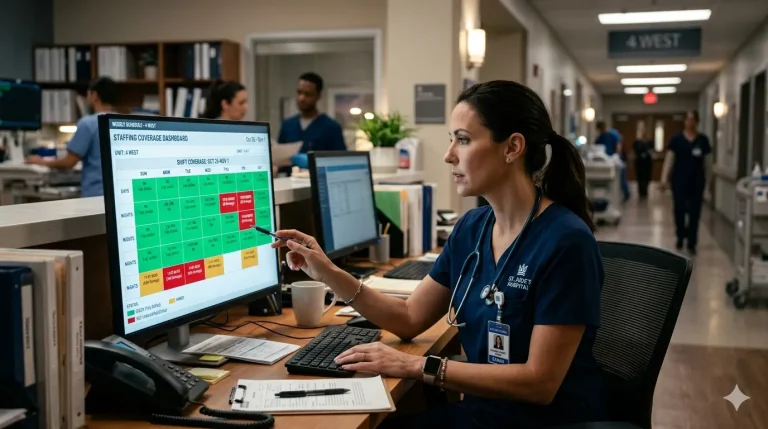
Managers get dashboards for team rosters, approvals, and analytics. The unit-level staffing view shows actual vs. required coverage in real time. Green means covered. Red means gap. Clicking into a gap shows available staff, budget implications, and fill options before you commit to anything.
Assigning access levels means not everyone gets the same permissions. Some staff see only their own schedule; others see entire departments or multiple units. This is worth setting up carefully during onboarding. Most login confusion from new staff traces back to permission settings, not the login process itself.
The analytics layer matters for anyone managing a budget. Every staffing decision in Smart Square carries a cost number alongside it. That visibility is what moves overtime from a reactive expense to a managed one.
Why SSM Health runs its workforce on Smart Square
SSM Health operates with more than 40,000 team members and 15,000 providers across Illinois, Missouri, Oklahoma, and Wisconsin. At that scale, you can’t manage scheduling through spreadsheets and phone calls. The coordination complexity alone would consume every scheduling coordinator’s entire week before they got to anything else.
Smart Square centralizes the whole operation. A float nurse who works across 3 units sees all her schedules in one place. A manager at one facility can see whether there’s coverage capacity at another before making an agency call. Every open shift in the network is visible, fillable, and trackable from the same system.
The payoff is measurable. Health systems that implement census-driven scheduling platforms consistently see overtime spend drop 10-15% in year 1. Agency and travel nurse costs fall 20-30% when internal staffing decisions happen earlier. SSM Health is one of the largest employers in every community it serves, which means those percentages represent significant annual savings.
Common SSM Smart Square login issues and fixes
Can’t reach the login page. Double-check the URL. Some SSM facilities use campus-specific portal addresses. If ssm.smart-square.com doesn’t load, ask your manager for your facility’s exact login link.
Credentials not working. Your SSM network credentials are the ones to use, not a personal email. If you’re new and haven’t set a password yet, contact your manager or SSM IT.
MFA isn’t prompting correctly. Pre-approving the SSM app in your authentication app (Duo, MS Authenticator) speeds up access considerably. If MFA is breaking your login flow entirely, IT support is the right call.
Off-site access issues. Using a shared or public device is not recommended due to privacy concerns. Some SSM facilities also require VPN for off-site access. Check with your IT department if you’re consistently hitting walls from home.
Mobile app calendar not loading. Log out, log back in. If it keeps happening, check for an app update. The issue usually resolves with a fresh session.
SSM Smart Square vs. smart square HMH: what’s the difference?
Same underlying platform, different health system deployments.
Smart square hmh runs on Hackensack Meridian Health’s network via meridian.smart-square.com. SSM Smart Square runs on SSM Health’s network via ssm.smart-square.com.
Both are built on the same Avantas/API Healthcare platform. Both do the same things: scheduling, forecasting, shift management, payroll integration. The login URLs, credential systems, and specific configurations differ because each health system has its own IT setup.
If you’re an HMH employee, your portal is hmh smart square at meridian.smart-square.com. If you’re SSM Health, it’s ssm.smart-square.com. Don’t mix them up or you’ll spend 10 minutes confused about why your password isn’t working.
The bottom line
SSM Smart Square isn’t complicated once you understand what it’s for and how to get in. The login is standard. The features are built around what healthcare workers actually need: schedule visibility, easy swaps, and less administrative overhead.
In 2026, with healthcare systems under constant pressure, tools like Smart Square play a vital role in keeping operations organized and staff supported. SSM’s investment in a platform this size is a bet on the idea that better workforce coordination leads to better patient care. The data backs that up.
If you’re locked out, start with your coordinator. If you’re in and not using it fully, set up your mobile app and turn on notifications. The staff who get the most out of Smart Square are the ones who treat it as their daily workflow hub, not just a place to check their schedule once a week.