The 120-Day Foresight Model: How Smart Square HMH Revolutionised Staffing Productivity
For modern healthcare administrators, the “status quo” of manual scheduling has become an unsustainable fiscal burden.
As New Jersey’s largest integrated health network, Hackensack Meridian Health (HMH) manages 17 hospitals and over 36,000 team members across 500 locations. To maintain operational excellence in such a vast ecosystem, HMH moved away from reactive “firefighting” to a proactive, AI-driven workforce strategy known as Smart Square HMH.
The Staffing Crisis at HMH: Escaping 20-Year-Old Tech
Before the digital transformation, HMH relied on a legacy scheduling system that was 20 years old. This outdated infrastructure lacked the agility required for a modern health system; it could not facilitate self-scheduling and required cumbersome third-party software just to allow team members to select extra shifts.
The primary consequence of this fragmentation was FTE Leakage—a phenomenon where salaried or contracted staff fail to work their full committed hours while the hospital simultaneously pays for expensive overtime or agency labor to cover perceived gaps.
For an organisation where labor accounts for over 50% of operating expenses, this lack of transparency was a direct threat to financial sustainability.
Predictive Logic vs. Manual Entry: The Shift to “Authentic Intelligence”
The transition to Smart Square replaced manual spreadsheets with a predictive engine that synchronises the clinical workforce with anticipated patient volumes.
Unlike standard office calendars, this platform uses demand-driven logic that incorporates historical census trends, seasonal patterns, and real-time patient acuity data from Electronic Health Records (EHR).
This evolution represents a move toward what is now termed “Authentic Intelligence” (symplrAI), which identifies patterns in staff productivity and retention that human managers might miss.
By fuzing technology with the clinical mission, HMH administrators have been able to automate repetitive administrative tasks, allowing nurse managers to spend less time “hunting for hours” and more time focusing on top-of-license patient care.
Achieving 96% Accuracy: The 120-Day Forecasting Horizon
The most strategically significant feature of the Smart Square HMH platform is its 120-day forecasting window.
While standard nursing cycles typically look only four to six weeks ahead, Smart Square provides a clear view of staffing needs four months in advance with a staggering 96% accuracy rate.
This predictive lead time allows leadership to:
- Identify potential gaps months before they occur.
- Adjust core staff schedules proactively rather than relying on last-minute “incentive pay”.
- Refresh predictions weekly, ensuring the system remains responsive to shifting census trends and seasonal variances.
ROI: The $616,000 Result
By focusing on the single Key Performance Indicator (KPI) of FTE Leakage, HMH achieved measurable fiscal results in under a year.
Director of Nursing Business Operations, Tara Claudio, collaborated with nurse managers to use Smart Square’s dashboards to ensure all staff fulfilled their full commitments before shifts were offered to external agency staff.
The result was a dramatic decrease in leakage from 15% in 2022 to 8.5% in 2023.
This 6.5% reduction in inefficiency translated to $616,000 in direct labor cost savings for the network.
These savings were achieved not through service cuts, but through the precise optimisation of existing human capital.
Autonomy as an Antidote to Burnout
While the financial gains are undeniable, the human impact on the workforce is equally vital.
In an industry where 31% of systems are threatened by clinician burnout, Smart Square provides an “antidote” through mobile-first self-scheduling.
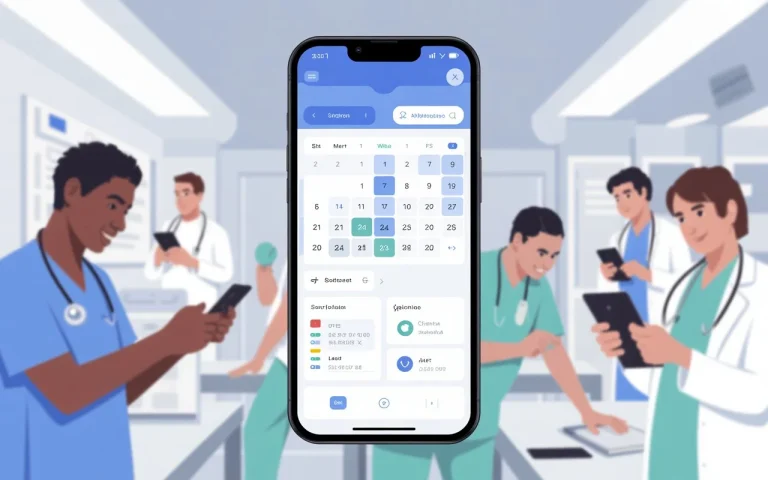
Clinicians can now access the portal from any web browser to view shift suggestions based on their skills and the unit’s demand, often building their entire monthly schedule in seconds.
This level of autonomy and transparency fosters a culture of trust and fairness, which is essential for retaining top talent in a competitive labor market.
Managers at HMH have noted that the system is one that “team members adapt to well,” proving that human-centered automation can enhance rather than disrupt the workforce.
Conclusion: The Roadmap for Operational Excellence
The HMH case study proves that predictive accuracy is the new fiscal safeguard for modern healthcare.
By integrating Smart Square into its innovative DNA, Hackensack Meridian Health has moved from a “confederation of hospitals” to a dynamic, integrated operating company.
For administrators looking to mirror this success, the directive is clear: standardise business rules, empower the clinician with mobile tools, and leverage a 120-day predictive horizon to reclaim the invisible budget lost to inefficiency.