Smart Square HMH: How This Scheduling Platform Cuts Overtime and Staffing Costs
Healthcare staffing is expensive. Overtime alone can eat 15-25% of a hospital’s labor budget. And that’s before you factor in agency nurses, last-minute shift scrambles, and the burnout that follows.
Smart Square HMH is built to fix that.
Used across Hackensack Meridian Health’s network, smart square hmh is a workforce management platform that handles scheduling, forecasting, and staffing analytics in one place. It’s not a calendar app. It’s infrastructure.
What is smart square HMH?
Smart square is a scheduling platform developed specifically for healthcare organizations. Hackensack Meridian Health (HMH) runs it across its hospitals and care facilities under the name hmh smart square or meridian smart square hmh, depending on which campus you’re on.
The core idea: replace spreadsheets, phone trees, and gut-feel scheduling with data-driven workforce management. Managers see staffing levels in real time. Staff see their schedules, swap shifts, and request time off without chasing down a charge nurse.
It’s built for complexity. Hospital staffing isn’t a 9-to-5 problem. You’ve got rotating shifts, union rules, patient census swings, certification requirements, and dozens of departments that all need coverage simultaneously. Smart square handles all of it.
How smart square HMH login works
Getting into the system is straightforward. Staff access the hmh smart square login portal through a browser, no app installation required. The smart square hmh login page authenticates through HMH’s single sign-on, so the same credentials you use for other hospital systems work here.
For staff who float between facilities, the smart square hmhn login covers the HMH network, meaning one login gives you visibility across multiple sites if your role allows it.
The smart square login itself is clean: email, password, done. First-time users get a setup prompt. Forgot your password? The reset flow takes about 2 minutes.
If you’re accessing smart square meridian from off-site, you may need VPN depending on your facility’s IT setup. Check with your department coordinator if you hit a wall.
The overtime problem in healthcare
Let’s talk numbers for a second.
A registered nurse in the U.S. earns roughly $40-45/hour on average. Overtime kicks in at 1.5x, so $60-67/hour. One nurse working 8 hours of overtime per week adds $19,000-22,000 in annual labor cost above their base salary. Multiply that across a 200-nurse hospital and you’re looking at millions in preventable spend.
The reason overtime happens isn’t usually laziness or bad intentions. It’s information gaps. A manager doesn’t know that 3 nurses called out on the same night until it’s already 6pm. By then, the cheapest solution is gone. Someone gets mandated. Someone else volunteers for time-and-a-half.
Smart square hmh closes those information gaps before they become expensive decisions.
How it actually reduces overtime
Real-time staffing visibility
The platform shows actual vs. required staffing levels by unit, shift, and skill mix. Managers see a gap forming 48-72 hours out, not 2 hours before shift start. That lead time is everything.
When you know Tuesday night is understaffed on Monday morning, you can post the shift, find a per-diem nurse, or redistribute staff across units. All cheaper than overtime.
Automated scheduling rules
Meridian smart square hmh enforces scheduling rules automatically. If a nurse is scheduled for 36 hours this week, the system flags any additional shift that would push them into overtime territory. Managers get a warning before they approve it.
This sounds basic. It’s not. In a manual scheduling environment, those rules live in someone’s head or a PDF nobody reads. They get missed constantly.
Shift bidding and self-scheduling
Staff can see open shifts and pick them up voluntarily. This matters because willing overtime (someone choosing to pick up an extra shift) is cheaper in practice than mandated overtime, in terms of morale, retention, and legal exposure.
Smart square hmh’s self-scheduling module lets staff bid on open shifts within the parameters HR and management set. Staff get autonomy. Management gets coverage. The coercive “you have to stay” conversation happens less.
Predictive forecasting
Patient census data feeds into staffing projections. If the system knows a particular unit historically needs 2 extra nurses every Friday after 3pm, it can build that into the schedule proactively. You staff to predicted demand rather than reacting to it.
This is where hmh smart square earns its keep on the analytics side. Historical patterns become scheduling logic.
Staffing cost reduction beyond overtime
Overtime is the obvious number. But smart square hmh hits staffing costs in a few other places too.
Agency and travel nurse spend. Agency nurses cost 2-3x a staff nurse’s hourly rate. Every time a hospital fills a shift with internal staff instead of an agency call, it saves hundreds of dollars on that single shift. The platform’s visibility into staff availability makes internal solutions more reachable.
Administrative time. Scheduling coordinators at large health systems can spend 20-30 hours per week manually building, adjusting, and communicating schedules. Smart square automates the grunt work. That’s coordinator time redirected to exception handling, staff support, and actual management.
Turnover costs. This one’s indirect but real. Nurses who feel like scheduling is fair, transparent, and gives them some control over their lives stay longer. Replacing a nurse costs $40,000-$60,000 when you account for recruitment, orientation, and lost productivity. Bad scheduling is a turnover driver. Smart square won’t fix culture problems, but it removes one of the most common friction points.
The manager experience
From a charge nurse or scheduling coordinator’s view, the platform is built around a few key workflows.
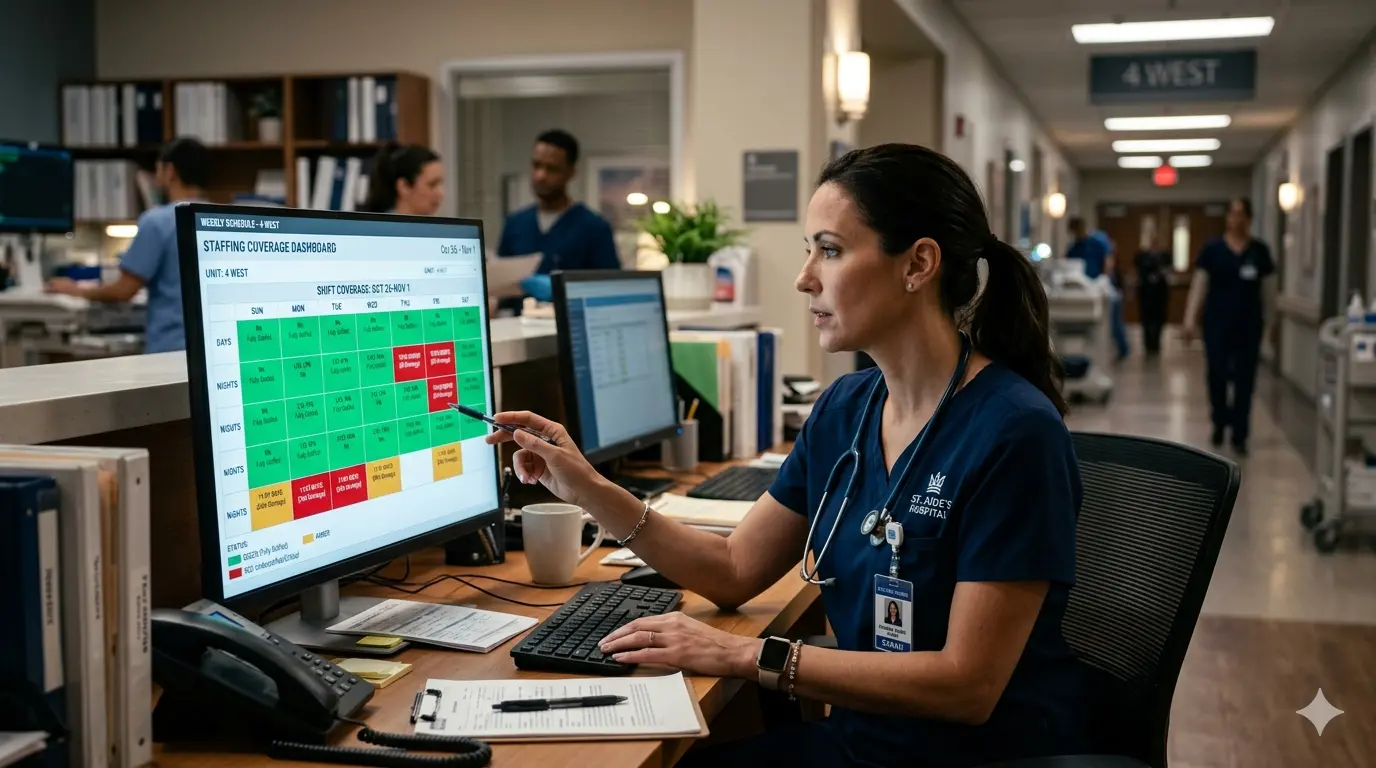
The smart square meridian dashboard shows unit-level staffing at a glance. Green means covered. Red means gap. Clicking into a gap shows who’s available, who’s already working that day elsewhere in the network, and what the budget implications are of each fill option.
Approving a shift swap takes seconds. The system checks whether the swap creates any compliance issues (overtime, back-to-back shifts, credential mismatches) and either clears it or flags it for review.
Float pool management is integrated. If your unit is short and another unit is overstaffed, you can coordinate a float within the platform rather than making phone calls.
The staff Experience
Staff who use the smart square login regularly cite a few things as genuinely useful.
Seeing your schedule 4-6 weeks out. In healthcare, that’s not always guaranteed. Smart square pushes schedules far enough in advance that staff can plan their lives.
The shift swap feature. Finding coverage used to mean texting your whole unit group chat and hoping. Now you post the shift in smart square, it notifies eligible staff, and you get a response without the group chat chaos.
Time-off requests with real visibility. Staff can see how many others already have that date off before they submit, which sets realistic expectations and reduces the frustration of denied requests.
Common questions about smart square HMH
Is smart square only for HMH?
The underlying platform (developed by Avantas, now part of API Healthcare) is used by health systems nationally. HMH’s implementation is branded as hmh smart square or meridian smart square hmh depending on the campus.
What if I can’t access the hmh smart square login?
Start with your unit’s scheduling coordinator. If it’s a credential issue, HMH’s IT help desk handles resets. If you’re off-site and hitting a network block, the VPN issue is usually the culprit.
Can staff see each other’s schedules?
Depends on your role and your facility’s settings. Most implementations give staff visibility into their unit’s coverage levels without showing personal schedule details for coworkers.
Does it integrate with payroll?
Yes, this is one of the core integrations. Hours worked flow into payroll systems, which is how overtime calculations and cost tracking stay accurate without manual data entry.
The bottom line on smart square HMH
Healthcare labor costs are going up. Nursing shortages make every open shift more expensive. Regulations around mandatory overtime and nurse-to-patient ratios add compliance complexity on top of the cost problem.
Smart square hmh doesn’t solve the shortage. Nothing does. But it makes the staffing you have go further. Real-time visibility, automated rule enforcement, self-scheduling, and predictive forecasting all work in the same direction: fewer surprise gaps, fewer overtime emergencies, less agency spend.
For a system the size of Hackensack Meridian Health, even a 5% reduction in overtime spend across the network is millions of dollars annually.
If you’re staff trying to access the smart square hmh login, your fastest path is your coordinator or the HMH IT help desk. If you’re in operations evaluating workforce management tools, the math on overtime reduction usually makes the implementation cost look small pretty quickly.
The problem with healthcare scheduling isn’t that people don’t care. They do. It’s that the information to make good decisions arrives too late. Smart square moves that information earlier in the process, and that’s where the money is.